
Parent guide
Your phone? Or a 6-axis robot arm?
For parents of students ages 11 to 18 (grades 6 to 12).
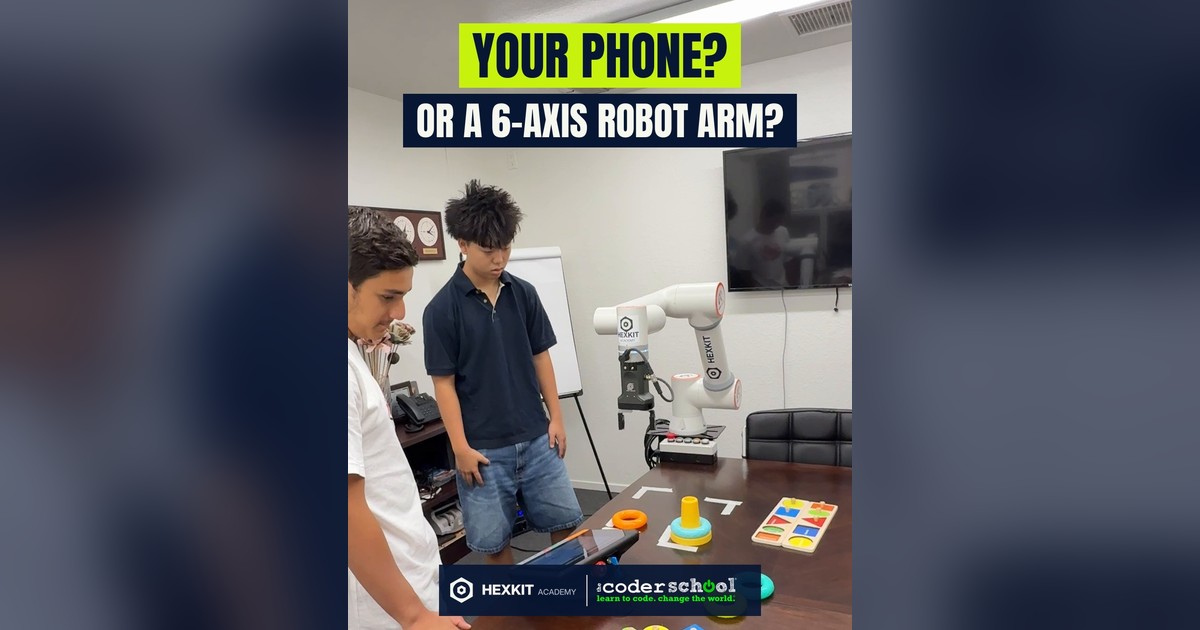
HEXKIT ACADEMY asks teens in Irvine one simple question: what if a couple of hours of screen time went into moving a real industrial robot arm instead?
A phone is an amazing machine. It is also built to keep you scrolling. A 6-axis collaborative robot, or cobot, is built for the opposite. It does nothing until you tell it exactly what to do. That difference is the whole point of this post.
The phone side of the scale
Parents are not imagining it. Pew Research Center's 2024 survey of U.S. teens ages 13 to 17 found that 95% have or can use a smartphone at home, and nearly half say they are online "almost constantly," up from 24% a decade ago (Pew Research Center, 2024).
Teens notice it too. In Pew's 2025 report on teens and mental health, 45% of teens said they spend too much time on social media, up from 36% in 2022. 44% said they have cut back on their smartphone use. 45% said social media hurts the amount of sleep they get, and 40% said it hurts their productivity (Pew Research Center, 2025).
And the hours add up. The Common Sense Census found that teens ages 13 to 18 averaged 8 hours and 39 minutes of screen media a day in 2021, and tweens ages 8 to 12 averaged 5 hours and 33 minutes. That count does not include screens used for school or homework (Common Sense Media, 2022).
None of this means phones are the enemy. Pew also found that most teens say social media helps them feel connected to friends. The real question is what else gets a share of those hours.
The robot arm side of the scale
A cobot is a collaborative industrial robot arm. It is the same class of machine engineers use to pick, place, sort, assemble and test parts. It is not a toy kit and it is not a video game. Read how a cobot class differs from a coding camp, or see the side-by-side comparison.
At HEXKIT ACADEMY, students work on a real 6-axis cobot. Six axes means six joints, like a shoulder, elbow and wrist that can each rotate. Getting the gripper to a precise spot means thinking about all six at once. That is real robotics engineering.
What a teen actually does on the arm
Here is how a typical HEXKIT ACADEMY session runs:
- Safety first. Every session starts with a safety briefing before anyone touches the controls.
- Teach one movement. Each student uses the teach pendant, the handheld controller engineers use, to teach the arm a pick and place move. Sort shapes. Stack rings. Line up cubes.
- Combine the moves. Students link their movements into one full program run.
- Show it. The arm runs the program for real. If something is off by a few millimeters, the arm shows you. You fix it and run it again.
That loop, plan, program, test, fix, is the same loop every engineer uses. The difference from a screen is that the result is physical. The ring lands on the peg or it doesn't.
Why it feels different from scrolling
- You are in control. A feed decides what you see next. A cobot waits for your instruction.
- Mistakes teach. A dropped block is instant feedback, not a lost streak.
- It is social in a real way. Students work in small groups at the same table, cheering when a run lands clean.
- Phones stay away. Near the robot, phones are put away. Nobody has to argue about it, because the arm is more interesting.
For parents: what you are really getting
Safety on real industrial hardware
Cobots are designed to work near people, but they are still industrial machines, and we treat them that way. OSHA notes that many robot incidents happen during non-routine work like programming, setup and adjustment, when a person may be inside the robot's working area (OSHA). That is exactly why HEXKIT ACADEMY sessions open with a safety briefing, keep groups small, and ask for closed-toe shoes, tied-back hair and no loose clothing or jewelry.
A real project for a college portfolio
A video of your student's own program running on an industrial arm is concrete proof of skill. It can be a strong story for a college application, a résumé or a robotics team. To be clear, HEXKIT ACADEMY is not college credit and not an admissions guarantee. It is real work your student can show and explain. For more, read Is robotics good for college apps?
Skills that are growing
Robots are not a niche anymore. The International Federation of Robotics reports that 542,000 industrial robots were installed worldwide in 2024, more than double the number ten years earlier, with about 4.66 million in operation (IFR, 2025).
The U.S. Bureau of Labor Statistics lists robotic engineers under mechanical engineering, a field it projects to grow 11% from 2025 to 2035, much faster than the average for all occupations. BLS notes that more complex automation creates demand for engineers who can design, integrate and maintain it (BLS). Learning to program a cobot early gives a student a head start on that kind of robotics engineering thinking.
For teens: why this is the cool option
Be honest. Which clip would you rather post: another scroll, or a robot arm running code you wrote?
On a cobot you get to:
- Drive a real 6-axis industrial arm with a teach pendant
- Program pick and place moves and watch them run
- Debug in real life, not just on a screen
- Leave with a demo you made, not one you watched
You don't need experience. You just need curiosity and closed-toe shoes.
How to start with HEXKIT ACADEMY
HEXKIT ACADEMY runs hands-on robotics in Irvine for students ages 11 to 18 (grades 6 to 12). The Courses page lays out two tracks:
- Middle School track (Levels 1 to 5): from cell safety and a first pick and place to designing a cell and presenting it. No experience needed.
- High School Advanced track (Bridge, then Levels 6 to 10): for students with robotics team, CAD, CNC or coding experience, moving into industrial scripting, Python control, ROS 2 and vision, end-of-arm tooling and a capstone.
Each level ends with a HEXKIT ACADEMY certificate of completion that unlocks the next one. See what students learn level by level.
Next up: Cobot Lab at theCoderSchool Irvine
The easiest first step is Cobot Lab, a 2-hour session where each student teaches a real industrial cobot one movement on the teach pendant.
- Who: Ages 11 to 18 (grades 6 to 12), grouped by age. No experience needed.
- Bonus: Parents watch a live demo in the last 10 minutes. Friends who sign up together are placed in the same group.
See the date, session times and details on the Cobot Lab page.
FAQ
Is a cobot safe for a middle schooler?
Cobots are built to work near people, and HEXKIT ACADEMY treats them as industrial machines. Every session starts with a safety briefing, groups are small, phones stay away near the robot, and students follow a dress code of closed-toe shoes, tied-back hair and no loose clothing or jewelry.
Does my teen need coding or robotics experience?
No. Cobot Lab and the Middle School track need no experience. Students with robotics team, CAD, CNC or coding experience can take the High School Advanced track.
Is this a toy robot?
No. Students work on a real 6-axis industrial collaborative robot arm and program it with a teach pendant, the same type of controller engineers use.
Does this count for college credit?
No. HEXKIT ACADEMY does not give college credit. Students do leave with real project work, like a program they wrote and a run on the arm, that they can use in a portfolio or application.
Where are HEXKIT ACADEMY classes?
In Irvine. The next Cobot Lab is at theCoderSchool Irvine. See the Cobot Lab page for details.
Put the phone down for two hours
The phone will still be there afterward. The chance to tell a 6-axis robot arm what to do, and watch it do it, is rarer. Start with Cobot Lab, explore the Courses, or learn more at HEXKIT ACADEMY.
Questions? Call (949) 414-4022 or email hello@hexkitacademy.com.
Sources
- Pew Research Center, "Teens, Social Media and Technology 2024," Dec 12, 2024. https://www.pewresearch.org/internet/2024/12/12/teens-social-media-and-technology-2024/
- Pew Research Center, "Teens, Social Media and Mental Health," Apr 22, 2025. https://www.pewresearch.org/internet/2025/04/22/teens-social-media-and-mental-health/
- Common Sense Media, "The Common Sense Census: Media Use by Tweens and Teens, 2021," Mar 9, 2022. https://www.commonsensemedia.org/research/the-common-sense-census-media-use-by-tweens-and-teens-2021 (full report PDF: https://www.commonsensemedia.org/sites/default/files/research/report/8-18-census-integrated-report-final-web_0.pdf)
- International Federation of Robotics, "World Robotics 2025 report: Global Robot Demand in Factories Doubles Over 10 Years," Sep 25, 2025. https://ifr.org/ifr-press-releases/news/global-robot-demand-in-factories-doubles-over-10-years
- U.S. Bureau of Labor Statistics, Occupational Outlook Handbook, "Mechanical Engineers" (includes robotic engineers), last modified Aug 27, 2026. https://www.bls.gov/ooh/architecture-and-engineering/mechanical-engineers.htm
- Occupational Safety and Health Administration, "Robotics: Overview." https://www.osha.gov/robotics